
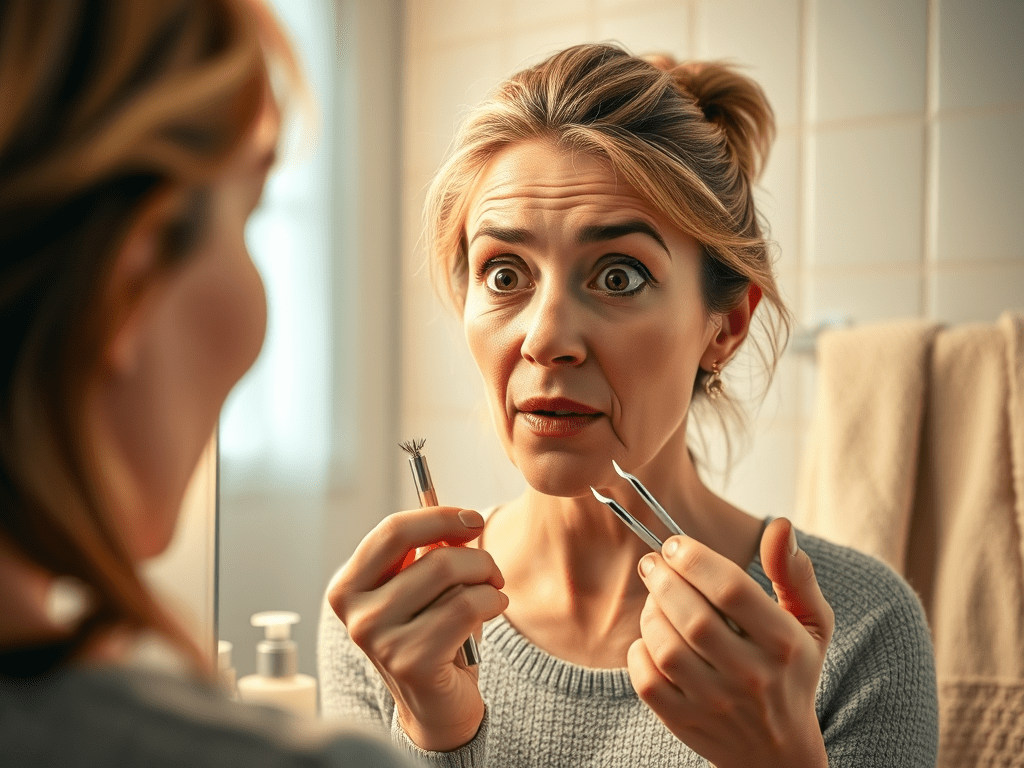
The Rogue Hair That Stole the Spotlight
I was well into my 40s when I met it: a lone, wiry chin hair glinting in the bathroom mirror. It seemed to appear overnight, twirling in the light like it had been there forever – truly, more committed to sticking around than my flaky college boyfriend ever was. One moment, I’m blissfully applying moisturizer; the next, I’m face-to-face with this tiny interloper. Cue the horror-movie music. With equal parts shock and dark humor, I greeted this surprise guest on my chin. Was it mocking me, or just making itself comfortable? Either way, I couldn’t help but laugh at the absurdity. Here I was, a grown woman who had survived plenty of life’s twists, now nearly unhinged by a rogue hair. If this isn’t a lesson in aging’s sense of humor, what is?
Of course, my first impulse was to pluck the intruder into oblivion. I grabbed the nearest tweezers (doesn’t every woman have a pair just for this?), muttering to myself about how this one strand had more tenacity than an ex who couldn’t commit to weekend plans. But as I yanked it out – triumphantly, I might add – I had a sneaking suspicion this wasn’t the last I’d see of it. Sure enough, like a bad romantic sequel, back it came in a few weeks. It turns out you can break up with a chin hair all you want, but it just isn’t going to take the hint. In the grand comedy of aging, that stubborn little whisker might as well be saying, “I’m not going anywhere, honey.” And oddly enough, once the initial outrage faded, I found myself more amused than anything. After all, if a chin hair is the most loyal thing in my life at the moment, I might as well hear it out.
Blame It on the Hormones (A Hairy Plot Twist)
So, what is the deal with this defiant chin hair? Am I cursed by a fairy tale witch, or is there a less fantastical explanation? Spoiler alert: it’s the hormones. As we age, especially as women approach perimenopause and menopause, our bodies go through a hormonal plot twist worthy of a soap opera. The hormone estrogen – which once helped keep our skin supple and most of our facial hair baby-fine – starts dialing back its presence. Meanwhile, our levels of androgens (so-called “male” hormones like testosterone) don’t drop as sharply. The result is a shift in balance: with estrogen no longer keeping every little follicle in check, testosterone’s influence gets a promotiongennev.com. In plain English, that means some of those soft peach-fuzz vellus hairs on your face can turn into sturdier, darker, attention-seeking strands. It’s totally normal biology: as one menopause guide quips, when estrogen leaves the party, testosterone has a greater influence – which is why a woman who never had facial hair in her 20s might suddenly find herself tweezing a chin hair at 45thebettermenopause.com. Surprise!
If this feels like nature’s idea of a practical joke, you’re not wrong. During puberty, hormone surges give teen boys their beards and mustaches – and even we girls might have noticed a few changes (hello, random body hair). Fast forward a few decades, and menopause brings another hormonal shake-up. Estrogen plummets, which not only can thin the hair on our heads but also frees the remaining testosterone to spark new growth in “fun” places like the chin, jawline, or upper lipthebettermenopause.comhealth.clevelandclinic.org. Importantly, it’s not that you suddenly have a ton more testosterone than before – it’s just that with less estrogen around, your tiny baseline levels of testosterone can activate dormant hair follicles that were there all along. Think of it like a seesaw: when one side (estrogen) goes down, the other (androgens) tips up in relative effect. That’s why these pesky chin hairs often crop up as part of the mid-life hormone remix.
Now, a single straggler or two is usually nothing to worry about medically. Dermatologists and gerontologists alike will tell you that a few random chin hairs are a common rite of passage as we get olderhealthline.com. In fact, virtually everyone has some facial hair – we just don’t notice the whisper-fine ones. How many new strands appear, and how dark or coarse they get, is highly individual. Genetics plays a role (so you can thank Grandma if you inherited the “sprouter” gene), and so do other factors like health and medicationsthebettermenopause.com. But for the majority of us, that one rogue hair (or its tenacious little group of friends) is not a sign something’s wrong – it’s usually just a sign of hormonal shifts and aging doing their thing. Unfair? Maybe. But abnormal? Nope. This is one part of menopause and mid-life that our biology textbooks forgot to warn us about. And if you’re muttering “thanks for nothing” under your breath at your fading estrogen, well, you wouldn’t be the first.
Beauty Standards and the “Bearded Lady” Stigma
Okay, so science says chin hairs are normal. But if they’re so normal, why did discovering mine make me feel like I’d grown a third eye? The answer lies in our beauty standards – those unwritten rules that have been drilled into us from day one. For ages (literally, ages), society has treated women’s facial hair as something taboo, something to be plucked, hidden, or apologized for. Many cultures flat-out associate facial hair with masculinity, not femininityhealth.clevelandclinic.org. We’re bombarded with images of women whose faces are as smooth as marble statues – no fuzz, not a whisker in sight. Meanwhile, the only “acceptable” image of a woman with a beard is, historically, the circus sideshow “bearded lady” meant to shock and provoke laughter. The unspoken message: a hairy woman is a joke, or worse, a failure of womanhood. Yikes. No wonder the appearance of even one little hair can send us into a minor identity crisis.
I’ll be honest: when I found my chin intruder, my first feeling (after the comedic disbelief) was embarrassment. I’m a grown woman who knows better – I write about aging, I preach self-acceptance – yet my gut reaction was, “What if someone sees this and thinks I’ve let myself go?” That’s how deep this conditioning runs. And I’m far from alone. In fact, one study found that women dealing with unwanted facial hair reported high levels of anxiety and even depression, and spent an average of 104 minutes a week fussing over ithealth.clevelandclinic.org. That’s nearly two hours every week devoted to plucking, waxing, checking and re-checking the mirror for renegade hairs! (If you’re wondering, that’s about as much time as my 20-something boyfriend at the time spent playing video games – clearly, we all have our priorities.) The point is, this tiny feature of aging can take an outsized toll on our confidence. We’re taught that it’s something to be ashamed of, a dirty little secret. As one writer put it, women have been keeping the existence of their facial hair so hush-hush, it’s like a shameful curse we must hide from lovers and friends at all coststheguardian.com. Harsh, but it captures the pressure perfectly.
The double standard here is almost laughable. Men sprout hair with abandon as they age – bushy eyebrows, tufts in the ears, entire lumberjack beards – and society just shrugs (or even finds it distinguished). A grey-bearded older man might be called a “silver fox,” while an older woman with a few chin hairs is urged to book a waxing appointment. From a young age, women get the message that part of being “feminine” means being hairless in all the right places, forever. It’s an impossible bar to meet, and it’s set by a culture that has long policed women’s appearances down to the last follicle. So if you’ve ever felt mortified by a stray hair, give yourself a break – of course you feel that way. We’ve all been swimming in this soup of expectations. Recognizing this ridiculous double standard is step one in reclaiming our sanity (and our tweezing time).
You’re Not Alone: Solidarity in the Sisterhood of the Chin Hair
Here’s the part where we kick shame to the curb. Take it from me and the countless women who’ve swapped whispered stories about that “one crazy hair” – you are so not alone in this. In fact, if you gathered a group of women over 40 (or younger – thanks, hormones and genetics!), I guarantee almost everyone would have a chin hair tale to tell. Some of us bond over the audacity of these little suckers (“Can you believe it was just sticking out like that?!”), and honestly, the camaraderie is real. Consider this your official invitation to the club – a club where we all roll our eyes at biology, share tips on good tweezers, and remind each other that a chin hair has zero bearing on our beauty or worth. There’s a strange comfort in knowing that virtually every woman has done the clandestine “chin check” in the car mirror or frantically plucked a hair in the bright light of day. It’s like a secret rite of passage that nobody told us about until we were already in it. So let’s say it out loud: having a chin hair (or three) is completely normal. We’re in this together, and frankly, we’ve got much bigger things to worry about in life than a couple extra follicles.
In recent years, there’s been a refreshing breeze of honesty and humor when it comes to these quirks of aging. Women are speaking up and sharing what was once unshareable. I’ve lost count of how many funny posts and articles I’ve seen where women openly joke about plucking chin hairs or compare notes on the best magnifying mirror. This openness is so important. The more we drag these “embarrassing” issues into the light, the less power they have to make us feel ashamed. It’s basically a form of geriatric guerrilla warfare against sexist beauty norms: we laugh, we commiserate, and we refuse to be shamed. Even some well-known figures have let the cat (or hair) out of the bag. (I’m pretty sure if you handed Michelle Obama a pair of tweezers, she’d know exactly what to do – she’s joked about her own mid-life stray hairs in interviews.) Every time someone with a platform admits, “Yep, I have chin hairs, so what?”, an angel gets its wings – or at least, a woman reading it feels a little less alone.
And it’s not just informal chit-chat; entire movements are pushing back on the idea that women’s bodies must be perfectly smooth. Activists and everyday women alike are embracing a bit of fuzz as a political statement. For example, body-positivity advocates like Harnaam Kaur have famously grown out their facial hair and post unapologetic selfies, proudly defying anyone who says it’s not “ladylike”theguardian.com. Their message is clear: Women have hair. Get over it. These brave souls highlight how absurd (and yes, misogynistic) it is to expect women to constantly rip out perfectly natural hair just to fit some narrow idealtheguardian.com. Social media accounts with tongue-in-cheek names like “hirsute and cute” have popped up, where members celebrate being exactly who they are – chin hairs and alltheguardian.com. It’s both hilarious and heartwarming to scroll through photos of ladies flaunting their little beards or mustaches with pride and a big grin. The takeaway? The conversation around aging and body acceptance is finally broadening to include those pesky chin hairs. Little by little, the stigma is eroding. We’re learning that you can be a gorgeous, confident, feminine woman and occasionally feel a tiny whisker on your chin – and it truly is no big deal.
Aging Gracefully (With a Dash of Humor)
At the end of the day, that determined chin hair of mine has taught me more than just the importance of good lighting and a quality tweezer. It’s been a tiny, funny reminder that aging is full of surprises – some annoying, some amusing, often both. I’ve learned to greet my persistent little chin visitors with a sense of humor and perspective. In fact, I even nicknamed one of them “Charlie” just to personify the rascal (it’s easier to curse a hair out when it has a name!). Rather than seeing it as an enemy, I’ve started to see it as a quirky badge of honor: proof that I’ve lived enough years to have my body switch up the script on me. One writer lovingly noted that her chin hairs actually made her feel closer to her mother and grandmother – a shared connection across generations of women who all dealt with the same thingharpersbazaar.com. I find that thought beautiful: in a way, these stubborn hairs link us in an unspoken sisterhood, a continuation of the women who came before us.
So, what’s the real deal with chin hair? It’s a little bit of science, a little bit of society’s baggage, and a whole lot of learning to say “who cares.” It has more commitment than that 20s boyfriend because it’s literally a part of you – programmed by your biology to stick around through thick and thin (quite literally). Unlike that boyfriend, your chin hair isn’t fickle; it shows up reliably, and if you banish it, odds are it’ll be back for a reunion tour. But here’s the silver lining: with every reappearance, you get another chance to practice acceptance…or at least refine your comedic material about aging. Pluck it, wax it, laser it, ignore it – whatever makes you feel good. Just remember that its existence is no reflection on your beauty or femininity. In fact, let that chin hair be a reminder that you’re human, that you’ve got history and hormones and a life story that’s still unfolding. And if it bothers you, you’re allowed to curse its commitment under your breath (I certainly have!). Then, carry on with your head held high. Because you, my friend, have far more important things to do than worry about a tiny hair on your chin – and deep down, you know that hair is lucky to hitch a ride with a woman as wise and wonderful as you.




 Unfinished Wisdom
Leave a comment