
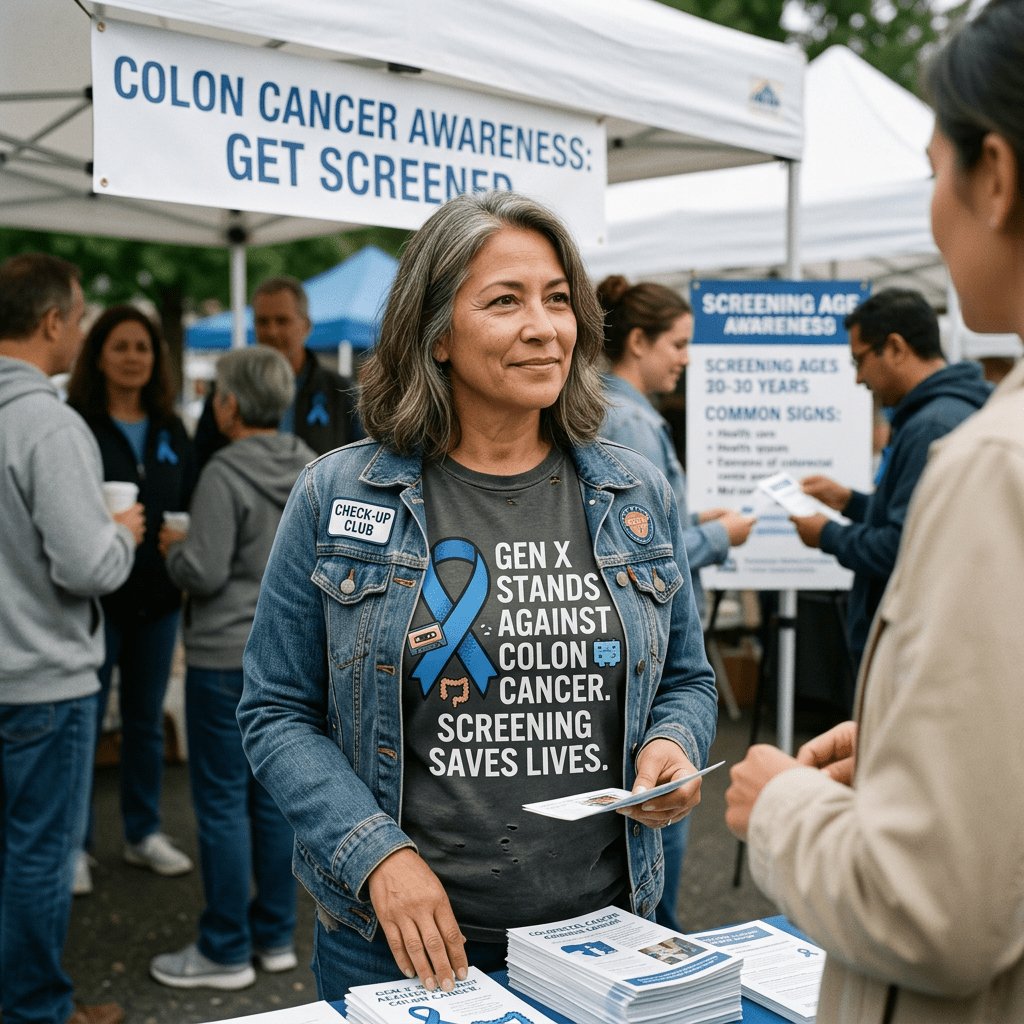
There’s a quiet conversation happening in doctors’ offices, research labs, and middle-aged group texts right now, and it sounds something like this:
“Wait… why does everyone suddenly know someone our age with cancer?”
For years, cancer was culturally framed as something that happened “later.” Retirement-age later. Grandparent later. Yet many people in their 40s and 50s are now finding themselves scheduling colonoscopies between soccer games, caregiving, work meetings, and figuring out whether their lower back pain is from stress, gardening, aging… or something more serious.
And researchers are paying attention.
Recent studies suggest that Generation X and younger adults are experiencing increased rates of several cancers compared to previous generations at the same age. Colorectal cancer has become one of the most alarming examples, especially rectal cancer in adults under 55. Researchers are also tracking increases in pancreatic, kidney, thyroid, uterine, appendix, and some breast cancers.
This is not simply a story about people living longer. Scientists believe this may represent what’s called a birth cohort effect, meaning people born during certain decades appear to carry higher risks throughout life compared to earlier generations.
Translation? Something about the environment we grew up in may matter.
And honestly, when you look at the historical timeline, Gen X becomes a fascinating and slightly terrifying epidemiological experiment.
We were the first major generation raised deep inside the processed food revolution. We microwaved our dinners on plastic trays while inhaling secondhand smoke in restaurants, cars, airplanes, bowling alleys, and probably church basements. We drank from garden hoses, survived on Tang, margarine, and fluorescent snack cakes, and spent years hearing phrases like “walk it off” from adults who themselves had untreated stress and hypertension.
Many of us were latchkey kids managing chronic low-grade stress before we even had language for anxiety. We came of age during the rise of diet culture, convenience foods, environmental chemical exposure, endocrine disruptors, sedentary work, and increasingly fragmented sleep patterns. Add decades of stress hormones, economic instability, disrupted eating patterns, alcohol normalization, and less movement than previous generations, and researchers start seeing patterns that are difficult to ignore.
Scientists sometimes use the term the exposome, which refers to the cumulative effect of everything we are exposed to across the lifespan. Not one singular cause. Not one evil villain hiding in a laboratory cackling over BPA-coated receipts. More like death by a thousand tiny modern inconveniences.
The hard part is that this conversation can easily drift into fear, blame, or wellness-culture nonsense.
This is not about “perfect living.” Plenty of healthy people develop cancer. Plenty of people with terrible habits never do. Biology has always been humbling that way.
But there is an important takeaway here:
We can no longer assume younger means protected.
That matters because younger adults are often diagnosed later. Symptoms get dismissed. Patients get told they are stressed, tired, hormonal, busy, overweight, aging, anxious, or “probably fine.” Sometimes they are fine. Sometimes they are not.
The lesson is not panic. It is attention.
Pay attention to persistent changes. Blood in the stool is not automatically hemorrhoids. Exhaustion that won’t resolve deserves evaluation. Ongoing digestive changes, unexplained pain, sudden weight loss, or unusual bleeding should not be brushed aside simply because someone is “too young.”
Gen X, in particular, was raised to endure discomfort quietly. Many of us became experts at functioning while exhausted, stressed, inflamed, under-slept, overworked, and emotionally constipated. We normalize symptoms because powering through became a survival skill.
Unfortunately, bodies keep receipts even when healthcare systems and workplaces do not.
And perhaps that is the real cultural shift happening now. Not just an increase in cancer awareness, but a growing recognition that health is not merely about individual choices. It is also about systems, environments, stress exposure, food systems, economics, healthcare access, social expectations, and the strange biological cost of modern life.
Gen X is not weak. We are not failing.
We may simply be the first generation old enough for the data to reveal what decades of modern living can do to a human body.
Which is both sobering… and maybe a very good reason to finally schedule that screening you’ve been avoiding since 2022.






Leave a Reply