
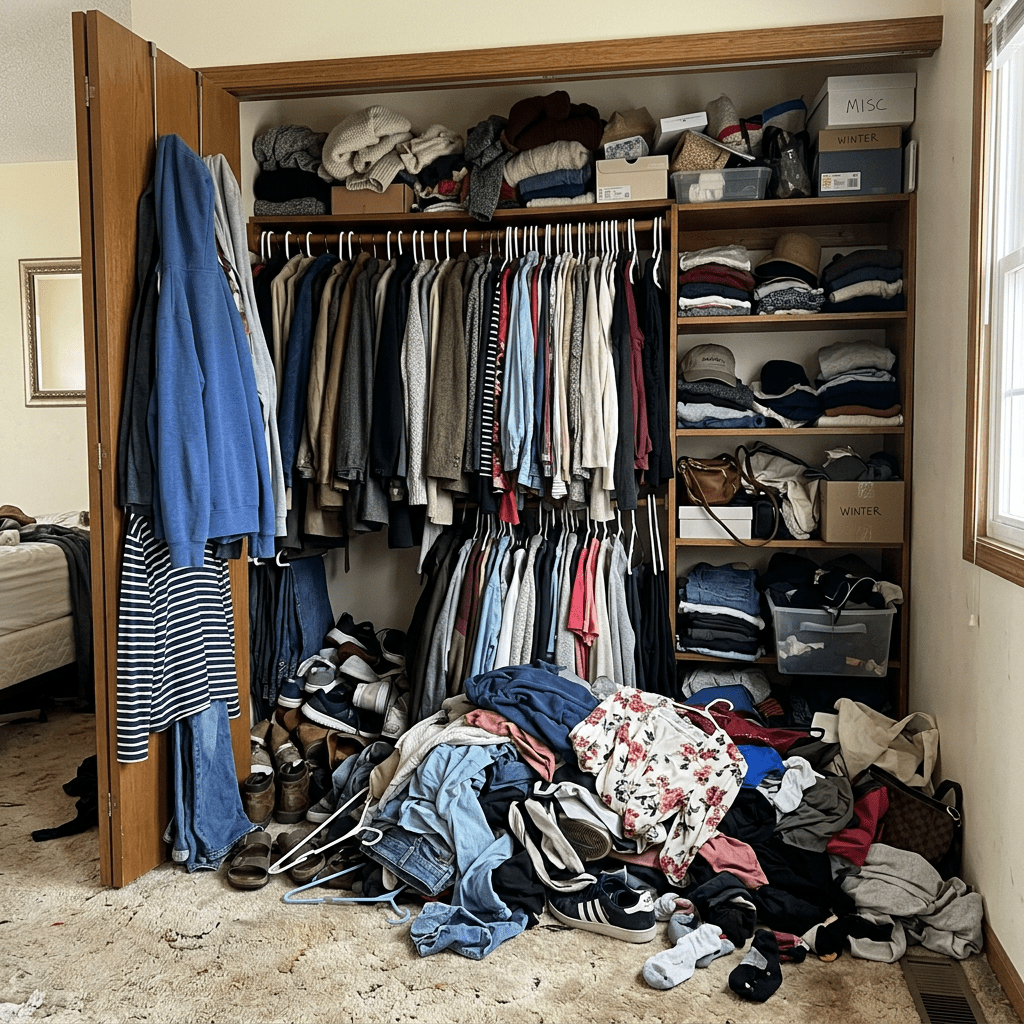
Admittedly, part of the problem was the Instagram rabbit hole that I found myself in.
What is my style archetype?
Am I a Warrior or a Mother?
Am I a Soft Autumn or a Warm Spring?
Every swipe seemed to promise another layer of self-discovery wrapped in a convenient package and accompanied by a purchase link. Apparently, somewhere beneath sixty years of life experience, changing hairstyles, shifting body shapes, accumulated possessions, and a lifetime of questionable decisions, there existed a singular truth waiting to be uncovered. All I needed was the right quiz, the proper consultant, or thirty dollars and a willingness to believe.
Because I am also acutely aware of the trap, I thought to myself, “Self, we can use AI as well as these developers. I don’t need to pay thirty dollars for this service if I can develop the right prompt.”
And that’s where it began.
What started as a style analysis quickly devolved into an existential investigation conducted from my living room.
There I sat, barefoot in a white linen and lace morning dress, watching Star Wars while discussing color theory with a computer. Somewhere between olive green, mushroom versus taupe, and whether black was secretly sabotaging my complexion, I found myself uploading photographs spanning decades of my life.
That was the moment things went sideways.
The discussion stopped being about style.
It became an archaeological dig.
At sixty years old, I have survived six decades of fashion and at least as many years of questionable decisions. Much of the evidence has long since disappeared. The shoulder pads are gone. The bustiers are gone. The prairie skirts are gone. The stirrup pants are gone. Thank God, some of the hairstyles are gone. Entire fashion civilizations rose and fell before eventually being donated, repurposed, or quietly escorted from the premises.
Yet I remember every one of them.
There was the army green ruffled blouse with shoulder pads and epaulets that owed entirely too much to Janet Jackson. There were the Madonna-inspired bustiers. There were oversized sweaters, giant hair, prairie skirts, stirrup pants, power suits, romantic florals, flowing bohemian layers, and enough trends to fill several lifetimes.
I can blame Rolling Stone, MTV, fashion magazines, department store mannequins, Instagram, TikTok, and every other cultural influence that crossed my path over the years, but the truth is much simpler.
I bought them.
I wore them.
In most cases, there is photographic evidence.
The funny thing is that I regret very little of it.
Well, almost very little.
There was the red linen gaucho set with the matching vest and tailored jacket that I wore on the first day of seventh grade. Even now, decades later, I can remember the sinking realization that what had looked sophisticated in the dressing room made me appear to be a very small middle manager attending a conference on agricultural policy.
Some mistakes leave a mark.
Most of the others, however, have become stories.
The shoulder pads tell the story of a young woman paying attention to her cultural moment and trying on adulthood. The bustiers tell the story of confidence, aspiration, and occasionally poor judgment. The prairie skirts tell the story of someone who genuinely believed she might someday live in a cottage and churn butter. The stirrup pants tell the story of a generation that collectively lost its mind.
The clothes themselves are almost beside the point.
What fascinated me while sorting through my closet was realizing how much of the evidence is gone and yet how present those earlier versions of myself remain.
I can walk into a store today, see a prairie dress hanging on a rack, and immediately remember exactly why I wanted one the first time. More recently, I found myself staring at a pair of leggings with stirrups and experiencing equal measures of nostalgia and horror.
Fashion, like history, appears to operate on a cyclical theory of time.
As I continued sorting, I began noticing something else. My current closet wasn’t filled with evidence of abandoned dreams. It wasn’t a museum of identities I had imagined but never lived.
The vintage dresses are there because I wear them. The cruise clothes are there because we cruise. The gardening clothes get dirty, the teaching clothes teach, and the writing clothes write. Even the infamous neon green travel set, which made me look like a highlighter with luggage, eventually found a second life as official Carnival Cruise Neon Night attire.
Most of these clothes were not aspirational.
They were functional.
Not because they covered my body, but because they supported different parts of my life.
That’s when I realized the style archetype quizzes had been asking the wrong question.
They assume there is one authentic self buried beneath the clutter. Dig deep enough and you’ll find her. Identify her. Curate her. Build a wardrobe around her.
But that isn’t what I found.
What I found was layers.
A style archaeologist would have a field day with me.
Every layer overlaps another. Every layer serves a purpose. Every layer supports the underlying architecture of who I am. Remove one and the story becomes less complete. The professor never replaced the dreamer any more than the practical woman replaced the adventurer. The grandmother exists quite comfortably alongside the girl who once thought shoulder pads were a good idea, and all of them seem to take turns making purchasing decisions.
The richness isn’t found by digging through the layers until you uncover the real me.
The richness comes from the layers themselves.
Perhaps that is one of the gifts of aging.
At twenty-five, I could only see the person I was in that moment. At sixty, I can see the continuity. I can recognize the young woman in the shoulder pads, the professional in the black cardigans, the aspiring Stevie Nicks in the flowing shawls, the vintage dress enthusiast, the cruise highlighter, and the barefoot woman in the linen morning dress watching Star Wars and discussing color theory with a computer.
None of them disappeared.
They became part of the architecture.
The internet wanted me to find my style archetype.
Instead, I found an archaeological site.
And if there is a lesson buried somewhere beneath all those layers, it may be this: the goal was never to discover the one authentic version of myself hiding beneath the clutter. The goal was to recognize that every version had contributed something worth keeping.
The closet was never the problem.
I simply have a bigger me than closet space allows.








Leave a Reply