

An entirely unscientific investigation into sex, aging, and the apparent inability to follow simple instructions.
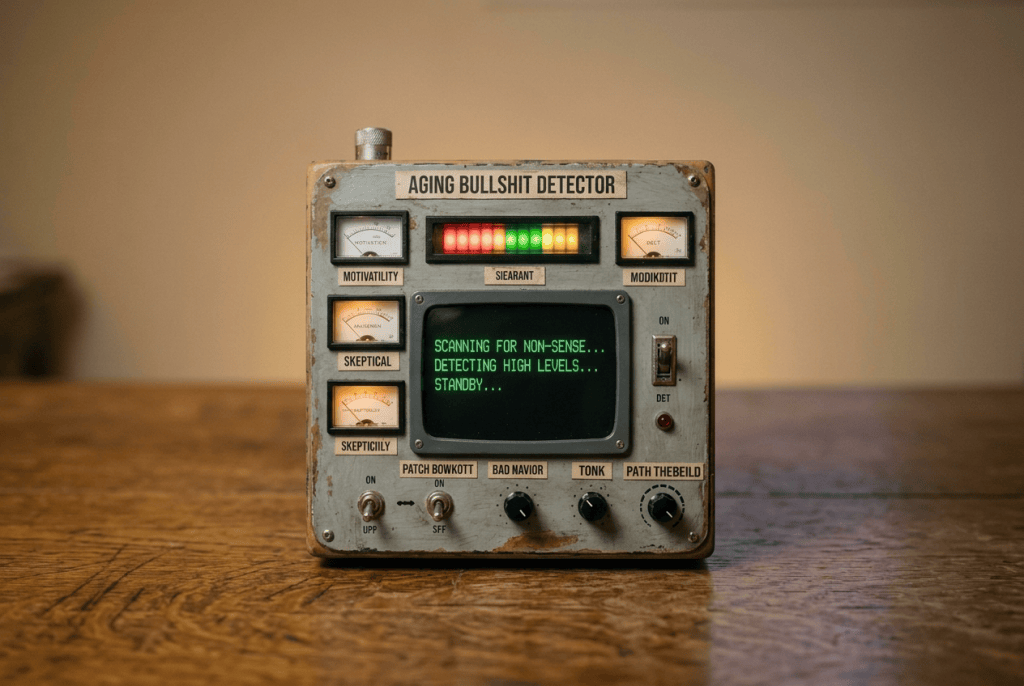
I’ve been thinking about sex. Not mine, particularly, so don’t get too excited. I’m thinking about sex as a rather peculiar aspect of human behavior, one that has occupied a remarkable amount of conversational territory among women of a certain age. And while I have absolutely no intention of claiming that my observations constitute legitimate scientific research, I would argue that the sample size is rather impressive.
Over the years, I’ve listened to friends, colleagues, acquaintances, and women from just about every walk of life discuss their relationships, their bodies, their partners, and the general absurdities of intimacy. Some conversations happened over wine, others over coffee, and a surprising number emerged entirely unsolicited during discussions that began with something innocuous, like gardening. There was no institutional review board, no randomized sampling, and absolutely no attempt to establish statistical significance. Nevertheless, certain themes have emerged with remarkable consistency.
Chief among them is the apparent inability of otherwise intelligent men to follow a relatively straightforward instruction: “Keep doing exactly that.”
Five words. No ambiguity, no hidden meaning, and absolutely no invitation to improvise. Yet, according to a substantial body of anecdotal evidence, somewhere between the instruction being issued and received, something goes terribly wrong. The speed increases, the pressure doubles, and what was apparently a perfectly pleasant experience suddenly resembles a small home renovation project. Which raises an important question: Why do some men interpret positive feedback as an invitation to introduce power tools?
I’ve considered recommending bells. On the men, obviously. A few strategically positioned bells around the waist could provide an excellent early warning system when enthusiasm begins to exceed recommended operating parameters. A gentle tinkling would indicate that all is proceeding nicely, while something resembling Santa’s sleigh arriving at considerable speed would suggest an immediate reassessment. This is not kink. This is occupational health and safety, and I think the idea deserves serious consideration.
Which brings me to the Kama Sutra. Who wrote that thing, anyway? And more importantly, how old were they? Because I’ve looked at some of those positions, and I suspect whoever was responsible had never experienced sciatica, a frozen shoulder, or the sudden realization that getting into a position is considerably easier than getting out of it. Surely, after sixty, we deserve an updated edition with helpful diagrams illustrating where to put the pillows, how to avoid aggravating an existing hip injury, and how to extricate oneself without calling the fire department.
Of course, the physical mechanics are only part of the problem. There’s also the peculiar mythology surrounding the female orgasm, which seems to have developed into something of a theatrical production. Women have spent decades being encouraged to communicate their sexual needs. Speak up, be assertive, tell your partner what feels good. Excellent advice, although it assumes that the person receiving the information is listening. According to my unofficial research, women frequently find themselves providing ongoing technical support, rather like the customer service department for a particularly temperamental appliance.
And somehow, while managing this operation, we’re also expected to produce spontaneous, uninhibited expressions of ecstasy. I’ve seen pornography, and I have to wonder how many women genuinely experience that level of screaming enthusiasm. Some undoubtedly do, and good for them. But judging by my conversations, a fair number are far too busy concentrating to provide a running commentary for an imaginary audience. Which makes me wonder whether the objective is to experience pleasure or to provide convincing evidence that pleasure has occurred.
And while we’re reconsidering expectations, why exactly is orgasm always treated as the grand finale? Sometimes sex is wonderful without one. Sometimes it’s an opportunity to be close, to enjoy each other, or simply to engage in something familiar and affectionate. Sometimes pleasure is something you give because you love someone, and sometimes it’s something you receive because someone loves you. And sometimes, quite frankly, you’d rather go to sleep. None of these scenarios requires a formal performance evaluation.
Which brings me, rather unfortunately, to the penis. And its feelings.
Aging can be unkind to male sexual function. Blood flow changes, medications interfere, illness takes its toll, and occasionally the equipment declines to cooperate. These are perfectly legitimate physiological realities, not personal failures. What interests me, however, is the curious tendency, reported frequently in my unofficial population study, to transform an ordinary biological event into an emotional emergency requiring immediate intervention by the female partner.
One minute, a couple is enjoying a pleasant evening, and the next, the woman is reassuring a grown man that he’s still attractive, masculine, desirable, and that the temporary reluctance of one particular body part does not signify the collapse of Western civilization. Suddenly, romance has become crisis management, complete with emotional support and possibly a motivational speech. Given my professional background in gerontology, I’m reasonably well qualified to develop an individualized care plan, but I draw the line at becoming a case manager for erectile uncertainty.
The penis, after all, is not a dependent minor. It does not require twenty-four-hour supervision, a designated caregiver, or a responsible adult to advocate for its needs. It belongs to a grown man who is presumably capable of recognizing that bodies change and that sometimes the most sensible response to an unexpected development is to laugh and try something different.
And before someone accuses me of being insensitive, women have been negotiating with unreliable reproductive equipment since puberty. Menstruation, pregnancy, childbirth, perimenopause, and menopause have provided decades of experience in adapting to bodies that don’t always cooperate. Then estrogen packs its bags and leaves without so much as a forwarding address, and activities that once required little thought suddenly demand more preparation. We investigate, adapt, experiment, and occasionally complain to our friends over wine. What we generally don’t do is expect our partners to restore our hormonal youth through sheer force of reassurance.
Perhaps the real issue is that we’ve confused sexual performance with sexual competence. We’ve become comfortable adapting to aging in almost every other area of our lives. We wear reading glasses, buy shoes with arch support, and abandon furniture that requires a mechanical lift to get out of. Nobody considers it a personal failure to need a larger font on their phone, yet acknowledging that sex might require a different approach can become an existential crisis.
And let’s not romanticize our sexual youth. Judging by the collective recollections of my unofficial research participants, those early encounters weren’t always extraordinary demonstrations of excellence. There was awkwardness, questionable judgment, and an astonishing amount of unnecessary urgency. Why spend our later years desperately trying to recreate something that might not have been all that spectacular in the first place?
So yes, I’m proposing a revised Kama Sutra, one with fewer acrobatic expectations and considerably more practical information. We could include a chapter on ergonomics, a section on equipment maintenance, and definitely a discussion of the appropriate use of household power tools. I would also recommend a refresher course in listening comprehension, preferably with a practical examination.
And, of course, there would be bells. I’m rather committed to the bells.
But perhaps the most important instruction could be printed in large letters on the inside cover: When a woman says, “Keep doing exactly that,” she means exactly that.
Perhaps the next edition of the Kama Sutra doesn’t need any new positions at all. Just a little more listening. Really listening, without filtering everything through our horny goggles. Although I still think the bells have potential.
Research disclosure: This essay is based on decades of informal conversations, observations, and entirely unscientific anecdotal evidence. No participants were recruited, no questionnaires were distributed, and no statistical analyses were conducted. The sample is almost certainly biased, the findings are not generalizable, and the author accepts no responsibility for any bells subsequently purchased.






Leave a Reply